Hog Hunting with IR Illuminator Pays Off!

My buddy and I always enjoy getting out a popping a few caps, but nothing beats a successful night of hog hunting in Texas. That is exactly what we ended up doing on this mild winter night. We knew that a herd of feral hogs had been coming into an earth tank regularly, but we’ve always been too late to the party. However, we headed out a little earlier tonight and crept towards the tank to see if any piggies were already there before we approached.

Of course, we didn’t see a hog around the tank. But then, we noticed a herd of hogs off in the distance — but moving in quickly. Then the footrace was on to see who could make it to the pond first! We rushed to reach the downwind side of the water and almost instantly the herd of feral hogs was upon us. It looked like our early start this night was really going to pay off on this hog hunting trip, and that a little pig population management was about to occur!
Hog Hunting in Texas at Night

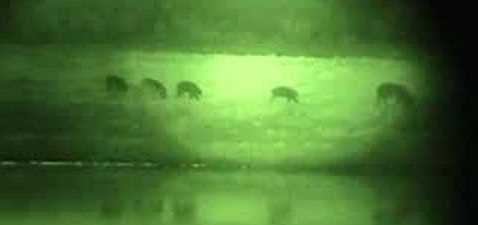
With the hogs at the small pond, we had no choice now but to hold our position with guns at our shoulders. Then, on cue, our IR illuminators lit up their eyes as they came running into certain death. Just as we whispered a countdown, face shots were given on the first two hogs. Hog Killer nailed his first one back in the snout and I shot through the eyeballs mine. Hogs starting scattering and shot after shot rang out in the panic. The pond yielded a total of five hogs and 3 took a kill shot straight to the face. The other two got it through the lungs.

We loaded up the better part of a truck load of hogs, then moved on to check out a field that has really been holding some animals where we have also been hog trapping. As luck would have it, we intercepted a lone boar in the field, just of some thick wooded habitat. Just to make sure this big guy went down quickly, we did a three, two and boom, firing simultaneously and dropping the wild boar right where he stood. You have got to love IR illuminators.

We loaded up our sixth hog just to get it out of the field and decided to call it a good night of hog hunting. We skinned out the four smallest pigs and put them in the two coolers we had, and are now looking forward to some tasty BBQ. Hunting has always been a passion of ours, but hog hunting at night with IR illuminators is just plain fun, especially when we end up with some great eating, too!
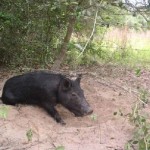
Feral Hog Control at Granger Lake

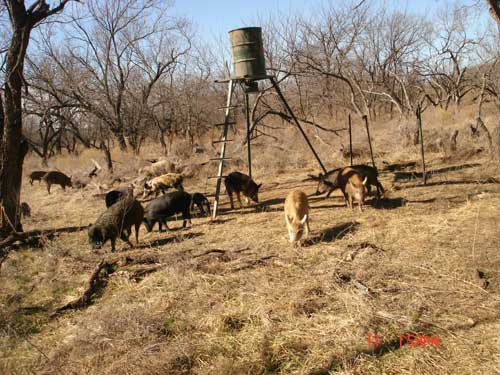
Feral hogs are not native to Texas. As most landowners know, wild pigs can cause a lot of damage and wreak economic havoc around farming and ranching operations. The blackland prairie ecoregion of Central Texas is well known for providing quality soils for crop production, but feral hogs negatively impact the farming operations found there. Although regular hog hunting activity occurs in this area, it does not occur at an intense enough level to limit hog populations.

The U.S. Army Corp of Engineers (USACE) land surrounding Granger Lake and the Granger Wildlife Management Area (WMA), which are located just northeast of Taylor, are no different. The area is accessible for hog hunting to the public, but even archery equipment is no match for the ever-moving hog population found there. The USDA Wildlife Services personnel have attempted to alleviate damage caused by feral hogs to grain crops surrounding a wildlife management area for the past 12 years.

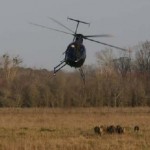
The hogs are damaging primarily corn and milo crops which border the 12,000 acre Granger WMA owned by the USACE and managed by the Texas Parks and Wildlife Department. Numerous methods have been attempted to lower the hog population and reduce the amount of damage suffered by the area farmers. Methods employed by Wildlife Services have included live hog trapping, shooting, snaring, dogs, aerial hunting, spotlighting, and the use of infrared and night vision equipment.

The success and results of these methods have been varied and are influenced by a number of limiting factors including cover, public use, and somewhat limited access to certain properties. Hunters know well that feral hogs can be difficult to hunt, but population reduction takes more than just hog hunting. Trapping, snaring and aerial shooting must also be a part of of hog population management, but local habitat and topography can influence control efforts and success.

Feral Hog Diseases Picked Up in Texas

Sportsmen across the country enjoy hog hunting because it can be a lot of fun as well as challenging, and the critters make good eating. But what do you know about feral hog diseases? Researchers in Texas warned Central Texas farmers, ranchers and hunters to use caution when handling wild game after finding evidence of an infection in feral hogs, one type of which is so lethal to humans it’s considered a viable bio-weapons agent!

A study out of Texas Tech University’s Institute of Environmental and Human Health warned farmers, ranchers and hunters this week to use caution when handling wild hogs after finding evidence of the bacteria that causes tularemia in feral hogs in both Bell and Coryell Counties. If you enjoy hog hunting in Texas, particularly the Central portion, pay attention. Fifteen percent of the feral hogs from the two Central Texas counties and 50 percent of those from Crosby County showed evidence of current or past infection.

Hog Hunting: Look Out for Feral Hog Diseases

Tularemia is a serious infectious disease caused by the bacteria Francisella tularensis. The zoonotic disease researcher who lead the team that tested about 130 feral hogs from Bell, Coryell and Crosby Counties reported it is not a feral hog disease to be taken lightly. In addition to feral hogs, rodents and other game animals as well as mosquitoes, deer flies and ticks, can carry tularemia, which is commonly known as rabbit fever. Researchers reported:

“We have found high levels of antibodies in these pigs that show they have been infected with Francisella tularensis and found that some of these pigs were actively infected with it. The bacteria are constantly present in animals in this area and the feral hog population, but normally it’s only a small number of cases. This is a huge number of infected animals.”

What the hog researchers have yet to determine is the subspecies of bacteria infecting the feral hogs of Central Texas. The Type B subspecies can cause illness in wildlife, domestic animals and humans, but poses a less serious health threat to humans. On the other hand, the Type A subspecies can be lethal to humans and the U.S. Centers For Disease Control and Prevention considers Type A a viable bio-weapons agent.

“If you are handling or cleaning or eating wild game, particularly hogs, deer or rabbits, you should be wearing rubber gloves and eye protection when you’re dressing wild game. The bacteria can enter any sort of small cut or hangnail. During this time of year, it might not be as big of an issue, but you should check yourself for ticks, wear tick repellent and avoid biting flies, including mosquitoes.”

The tularemia discovery was made while the researchers were actually looking for brucellosis. However, they found no evidence of that disease in feral hogs, and were surprised to find evidence of tularemia. Traditionally, it’s a rabbit disease, but it does get reported in birds and other mammals from time to time. Because wild hogs can range over large areas, it’s certainly possible that they can transport this stuff to different areas. Caution should be taken when handling and processing game in the field and home. In addition, make sure game meats are thoroughly cooked before eating them.

Between 2000 and 2008, only eight human cases of tularemia were reported in Texas. About 125 cases are reported each year in the U.S. Feral hogs can be found in 230 of Texas’ 254 counties, making for abundant hog hunting possibilities, but cause annual damages estimated at nearly $400 million. The potential spread of feral hog diseases, combined with physical damages caused by hogs, may make these animals more disliked than ever.